Monday, October 31, 2016

Climbing Diamond Head

Yesterday was Sunday, things were slow and Diamond Head has been beckoning so I wandered around the Waikiki area for awhile then caught the number 2 city bus to Diamond Head. Rather, I should say I rode the bus to the Kapiolani Community College, the end of the line. From there I walked about a mile up the Diamond Head Park access road, through the tunnel and into the crater.

Most people drove or rode the trolley to the parking lot near the entrance to the park. I was one of the few who took the city bus and walked through this tunnel built in 1943 by the Army Corps of Engineers. The tunnel was wide enough for cars to go both ways at once but if a trolley came along oncoming traffic had to wait since the trolley drove through the middle of the tunnel. 


There is a small park near the entry booth but most people come here to climb to the top so they pay a five dollar fee to park and a dollar per person fee to access the climbing trail. 


The trail was built in 1908 by the Army Corps of Engineers and was used by pack mules and the soldiers who manned the guns and fire control center.

From this point it looks like a stroll in the park but the sidewalk soon ends and the old trail takes over. If you look between the tree branches at the top right center you can see the lookout at the top, elevation 761 feet above sea level.

The trail winds back and forth up the inside of the crater wall. The corners are wide, I suppose so the mules could navigate the trail back in the day. Here you can see the trail including the empty part that leads to the lower left in the photo.


This tunnel is barely wide enough for two people to pass.
There are several sets of stairs. This is one of the longest.

It was windy on top.

Inside one of the old firing centers.


There are plenty of view points at the top but there are the idiots who ignore the signs, climb over a six-foot cyclone fence and walk the ridge out to another old fortification. I wouldn't mind if they fell off, that would be natural selection at its best. I do mind that they wear down the fragile ridge so future generations won't be able to enjoy the place like we do.
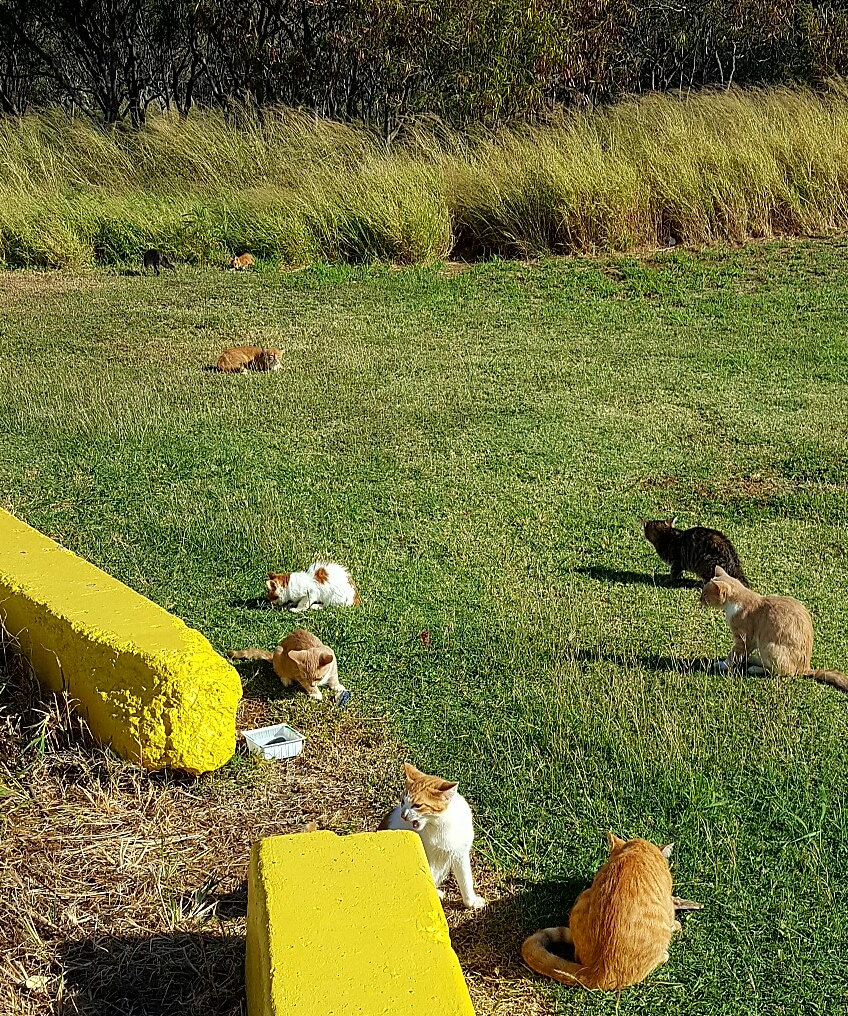
Back down at the bottom of the trail I was headed out the access road when I noticed these cats in a field alongside the roadway. Someone had given them pieces of mackerel and filled the water dish.It's hard to see them but there were several cats along the grass and woods near the top of the photo. I guess they make their home in the woods. 

I've been reading about the conflict between the feral cat lovers and the defenders of the native Hawaiian Monk Seals. Apparently the cats shed eggs of a parasite that kills the seals. There have been attempts to control the cat population but so far no solution has been found. If you're interested you can read more here:  http://www.newsday.com/news/nation/hawaiian-monk-seal-deaths-blamed-on-stray-cats-1.12464034

Leaving the feral cats and the Diamond Head park I made my way back down the access road to the bus stop and then back to our condo.

It was an enjoyable hike up Diamond Head. I was tired and ready for a nap when I got back but I recommend the trip. The view is worth the expenditure of energy to get there.


Sunday, October 30, 2016

Food Fo Fill Dah Belly in Honolulu

Foods from many countries can be found in Seattle and other cities around the world but here in Hawaii ethnic foods from other cultures are adopted and often adapted to fit the tastes of the locals as well as the original importers. Some dishes have become staples and "fill dah belly" any time any place.
The Hawaiian musubi is a takeoff on the Japanese omusubi or onigiri and is a very popular snack throughout the islands.

There are lots of Japanese tourists so many stores, especially in Waikiki and the big malls have signs in both English and Japanese.

The musubi below are typical. A block of rice topped with fried spam, avocado, sweet scrambled egg, or other protein and wrapped with dried nori (seaweed).
Samples of musubi (left), onigiri (center) and bento (left)
In this store they also had typical Japanese onigiri, rice balls filled with chopped pickle, umeboshi (pickled plum) or shredded salted salmon and wrapped with nori. To the left are bento boxes with a simple box lunch of rice, protein and pickle.

Poke is an old Hawaiian preparation of dried salted fish that could be carried on ocean journeys. In the old days it was often made of the scraps cut from fish when preparing the steaks or fillets. In the 1970's the concept began to spread and soon became popular as an appetizer or entree using Ahi (yellowfin tuna) and other fish and shellfish. Now it is made from many kinds of fish, shellfish, octopus, squid and even vegetables and tofu. There are a variety of sauces so the choices are many.
Poke counter at Don Quijote supermarket wihere I counted 28 kinds of poke.
Across the street from our condo is a local pass through window of a famous poke restaurant in Chinatown. We got some poke bowls to eat in our condo.
The Maguro Brothers take out window across the street.
Ramen is another common food in Hawaii. When walking to the beach this ramen place, Nakamura Ramen, caught my eye. They serve ramen with several kinds of sauces, with or without a soft boiled egg and with various kinds of protein.
The sign on the window says "Oxtail ramen."
I wanted to try their oxtail ramen so ordered the oxtail ramen set which included the ramen, some fried pot stickers (gyoza), a dish of fried rice and a bowl with ground ginger and soy sauce to be added as desired for extra flavor. I ordered the small plate of kimchee on the side.
The oxtail ramen set was well worth the price.
The ramen was very good although the price was a little high at $23.50, but that included the other parts of the set so altogether not so bad.
Testimonials from famous visitors from Japan.
There is a Japanese food court in the Ala Moana Mall. When we visited there I ordered a special ramen with soft egg and pork belly. It was delicious even though the sauce was quite rich.
Ramen at the Shirokiya Food Court had pork belly, soft boiled egg, chopped seaweed and green onions. Delicious.

Udon is another noodle dish found in Honolulu. There is a popular udon place about two blocks from our condo so I found myself having breakfast there the other day.
Plastic display dishes out front.

My udon with soft boiled egg and tempura fried Hawaiian sausage and mushrooms. It made a fine breakfast.

Cafeteria style udon restaurant with various kinds of soup and extras.

When you've had enough food it's time for shave ice. Shave ice is a completely different dish from what we on the "Mainland" know as a snow cone. 

Here in Hawaii the block of ice is put into a machine with a razor sharp knife on the bottom. The block of ice is locked in place then rotates while a very thin shaving of ice falls from the bottom. Many newer shave ice places have a machine that puts out an ultra thin layer of ice, almost like snow. It's every bit as smooth as the best of the rotating machines but not as authentic. 

The ice is packed gently into a dish, some places put a layer of ice cream on at this point, while some places add a flavored syrup here. More ice is packed on top then the people get creative with different kinds of syrups, fruit or other toppings and then sweetened condensed milk is often drizzled over the whole thing.
  

Blueberries, strawberries and small pieces of mochi at highly rated Island Vintage Shave Ice.

Matcha, sweet red beans, and strawberries with mochi.

Strawberry mango with mango poppers and mochi.


Saturday, October 29, 2016

Royal Aloha Waikiki


Dancing girls at the Kona Airport on the way from the Big Island.
Well, it's been a slow week in the new condo in Honolulu. We've done a little sightseeing, ate some (a lot of) local food and just relaxed. Of course, I guess that's what vacations are all about.
View of the gardens from our Hale Koa room where we spent one
night waiting for our Monday check in at the new condo.
Seaward side of the Army Museum at Ft DeRussy next door to the Hale Koa Hotel.

The Royal Aloha Vacation Club has units in three buildings here in the Waikiki area. We are in the Royal Aloha Towers about a block south of Ala Wai Channel, about four blocks north of the beach and about two miles from Diamond Head. In addition to the condos here in Honolulu Royal Aloha has units in Maui and Kona, Hawaii; Lake Tahoe; Branson; Acapulco; Chandler, Arizona; Otter Rock, OR, and Marbella, Spain.
Diamond Head from the beach in front of the Hale Koa Hotel.

This condo is a two bedroom, two bath with the usual amenities. Nothing fancy but a good location and a clean place to call home temporarily. We haven't stayed at any of their other units but based on this unit we would be willing to give them a try.
A little red head under the tropical trees.


From our home base it's an easy walk to the big public Waikiki beach, ten minutes to the Army Museum at Ft DeRussy, twenty minutes to Ala Moana mall (the biggest mall in Hawaii) and restaurants too numerous to count. In addition there are buses that go everywhere.

Not far from our building we found the Trump Hotel.

Colorful flowers abound here in Honolulu also.

The public is guaranteed access to all beaches in Hawaii but there are some that are dedicated to public use. The large public beach at Waikiki is an example of such a beach.

The big public beach at Waikiki with many concessions and amenities.

I admire the shape of the tropical trees. There are the lanky palm trees and the busy mimosas. Then there are the stereotypical shape of the "umbrella" trees.

Friday, October 21, 2016

Tropical Flowers to Cheer Your Day

Here in Hawaii the flowers bloom year round.

It's always a pleasure to visit the tropics this time of year when it's cold and dreary at home so I thought I would post some photos of the flowers around our condo to bring a little warmth into the hearts of you who are living north of the flower zone.
Plumeria have nice flowers and leaves
I haven't seen any of the other colors of Plumeria in this area. Maybe these white-yellow flowers are acclimatized to this area where it is particularly dry.


Hibiscus of many colors grow in the area. Many are hybrids.


Flowering trees are everywhere.


Bougainvillea of many colors are formed into hedges. Some are allowed to climb naturally.
 Ground cover with flowers.

More ground cover in bloom.

Hope you enjoyed seeing the bright flowers of the Big Island. Our week is drawing down and we head to Honolulu Sunday. I'll see what can be posted from there.


Thursday, October 20, 2016

Autumn in Waikoloa

This time of year in Seattle tends to be wet and cool. But here we are in Hawaii, on the Island of Hawaii (also known as The Big Island), near the town of Waikoloa.
Gray Line tourist map of Hawaii
If you enlarge the map you will find Waikoloa and our condo at Paniolo Greens just about due west of Mauna Kea, the northern large mountain.  The elevation here is 410' although it seems higher because of the view down to the lava flows and ocean to the west.

It's the same time of year here but things are a little different in this part of the country. Today's temperature here in Waikoloa Town is forecast to range from 71 to 89 degrees Fahrenheit with winds NNE 10-20 mph with "abundant" sunshine. This time of year those winds (Trade Winds) blow 90% of the time. Only when there is a low pressure zone about 500 miles to the northeast of Hawaii do the winds reverse and blow for a day or two from the SSW bringing rain to this normally dry side of the island.

Our condo is situated on the second and third floors of the building. The entrance is on the south and the lanai on each floor faces almost due north overlooking the second and third holes of the golf course with Kahala Mountain in the distance.
Kohala Mountain just after sunrise this morning. Taken from the third floor lanai
This morning was the first time I've seen the top of the mountain since it is usually shrouded in clouds. I would judge the wind to be blowing right at that 20 mph forecast, if not a little harder so that may be a help in keeping the summit clear of clouds. 

The golfers hit down the number two fairway which runs parallel to our building. Many of them end up in one of the two traps that guard the green in front of our condo. I went out and checked last night and found the traps have a thin layer of small gravel covering a hard base. Pity the poor bloke who tries to hit out. Many of them just pick up and throw their ball onto the green.

Number three is a par three that crosses the pond behind the eucalyptus tree in the foreground. The men's' tees are off to the left in the photo. Even the white tees require a good strong shot into the wind to reach the green just on the other side.  Red tees are just to the right of the two Norfolk Pines so the ladies have a much easier shot at the green.

An hour after sunrise the golfers are hard at it fighting that wind. Taken from the second floor lanai.
From the other side of our digs we look east at Mauna Kea where we can make out the observatory domes glinting in the sunlight. To the south southeast we see the wide dome of Mauna Loa which so far has been covered by clouds.

Moving away from the condo complex at Paniolo Greens there is a small shopping center about half a mile away where we ate dinner last night at a nice Italian Osteria. There is also a grocery store and some small shops in that area. Other than that the area is given over to condos, lava fields and smaller houses with other villages at least fifteen minutes away, down the hill. 

Tomorrow I'll post some photos of the local flowers to show what the flora of Hawaii looks like this time of year.


Tuesday, September 20, 2016

Observations While Walking my Dog

My guard dog, Kuro, watching for bad guys while I watch Elliott Bay
When Kuro and I walk around our part of this planet we observe some interesting things. In some cases those observations seem pretty mundane but in others they seem profound. I won't label any of these observations one way or the other but I think there may be some of both and maybe a couple of 'tweeners.

A walk begins with the first step. I'm sure you have heard this old saying in various expressions but the fact remains, you can't start a walk (or a journey) unless you take that first step.

Sometimes I am uncertain whether the weather will permit a walk and sometimes I'm tired or would rather do other things. Kuro is a firm believer in this adage and when that time of day rolls around there better be a good reason for not heading for the door. Only a full blown rain storm or maybe a blizzard might dissuade him. Although, come to think of it, Kuro hasn't seen a blizzard in his three plus years of life.

In any case, when it's time for a walk he won't let me make excuses, so off we go by taking that first step,

Our brains are amazing. Our brain has often been likened to a computer. It can tell time with great accuracy. I haven't used an alarm clock for many years because if I set my mind it works better by bringing me out of sleep gently within a minute or so of the desired time. It is also good at telling direction. It probably would be better if we trusted it more and let it lead but we tend to mistrust our brain and depend on Google Maps or a compass or, you get my drift.

Our walks cover mostly city streets with their sidewalks and curbs. I've noticed that when I'm not paying attention my brain measures the distance to the next curb or pothole or broken sidewalk raised by a hidden root. As we near the obstacle unconsciously my stride lengthens or shortens as required to take several, seemingly full strides, before stepping up onto the curb or raised sidewalk or whatever. 

If I pay attention to the process it seems I can tell up to about eight steps in advance which foot will go onto the raised curb or other obstacle. It seems uncanny and accurate except when my normal stride would result in a half step and then my brain won't tell the part that communicates with me which foot. If I don't pay attention, as mentioned, it's all automatic. 

A whimsical sunset near home in Seattle
Noo clouds, no sunset. Around the Pacific Northwest we have lots of gray skies so people appreciate blue sky and sunshine. I like the blue sky too but I also know that if there are no clouds we won't see a beautiful sunset. When the sky is completely covered with clouds out into the Pacific we won't see a sunset either but we need some clouds to have one of those beautiful sunsets we all like. Next time you wish for a clear blue sky remember, if your wish comes true you won't see a spectacular sunset that night.
A spectacular sunset over the Pacific near Mexico last January

Seasons change despite my earnest entreaties. Especially near the end of one season or another I find myself wishing that we might have another week of that pleasant season before the next one starts. It never seems to do any good. The hand of Mother Nature moves despite my desires.

Sometimes I think I've been successful and the ending season seems to linger for an extra burst but then I'm shocked to see it leave after all. When we walk I need to remember to observe the weather, the flowers and plants, the temperatures, the sky and the feel of that season because it will soon change.

People tend to reciprocate. As I remember my youth, everyone I passed on the street would return a wave. Today it's not quite as certain, but I've found that even with the increased isolation and retreat into electronic devices we experience today, if you wave and say, "Hello" people will return the greeting. If I walk with my head down and ignore passersby, they too walk on by without a greeting or wave.

Another difference from my youth is the studied avoidance of looking at other people in today's America. I guess women and girls are taught not to look at people in case it might be taken as an unwelcome invitation but in the last fifteen or twenty years I notice that people in general of both (or should I say all) sexes, avoid looking at others on the sidewalk. Here again, I have found that if I look directly at them and say, "Hello," more than half will return the greeting.

In other parts of the world, particularly Asia, the custom of not looking at your fellow travelers has not taken over yet and people there will still look you in the eye as they pass and often nod a greeting.

Strangers are hard to read. This might be a corollary of the previous observation. We can't tell by their appearance if strangers, people or dogs, will be friendly.

Sometimes the meanest looking dog or his human will turn out to be very friendly and sometimes the nice looking guy will growl at me without justification. I think dogs have better manners.

Walking uphill is harder than down. Now, you might say, "What kind of dumb observation is that? Of course it's easier to walk downhill." But as the TV pitchman said, "Wait, there's more..."

When we go out walking I like to start uphill first because I'm fresh and I can get the harder part done early. Sometimes when I'm tired or not very enthusiastic I'll start downhill first because I find that once I get a few blocks into our walk I feel better and don't mind walking back uphill when required. Kuro doesn't care which way we go as long as we go.

Our walks vary in distance from 20 minutes or about one and one-half kilometers to an hour or about four and one-half kilometers.  Sometimes I think I'll take a short route but after a few blocks I begin to enjoy the evening and my company and we stretch it out to a longer walk. When we start off uphill I know we'll be having an easier time on the return so it's easier to go for the extra blocks and enjoy the neighborhood.

Stop to smell the roses. In the spring and summer I like to smell the roses because they are fresh. Some of their flowers are very aromatic and some have very little smell. I can't tell which is which so I stick my nose in them all and am often rewarded with a wonderful fragrance. Kuro sniffs all the plants too but he's not stopping to smell the roses, he's checking to see which of his friends has been along that way.

We never know what's around the corner. Kuro learned early on to look around all the corners whether we are turning that way or not. He knows there might be another dog or, better yet, a cat or a squirrel, or even better, a boy on a scooter. Cats and squirrels run away and boys on scooters make such an interesting noise he can't help barking and chasing.

I, too, look around corners, not just while walking but in other places where the unexpected can make an appearance. Maybe it's a sign of advancing age but I keep an eye out for the other driver that didn't see the stop sign, the child who hasn't yet learned to beware of cars or the pet that can't resist running across the street after that tempting squirrel.

Carpe diem. This ancient phrase from the Roman poet, Horace, is usually translated as "seize the day." In modern times it seems to be construed to mean "Grab all you can today and don't worry about tomorrow," but I think Horace was encouraging the reader to do what is possible today to increase the odds for a better tomorrow.

When I feel a little sluggish or tired I try to remember that walking is a great way to exercise, breathe some fresh air and raise my spirits. For a better tomorrow, try walking today. If you have a little dog to keep you company, so much the better.


Sunday, August 14, 2016

Thrashing Time

Yesterday I had occasion to drive to Bellingham. It was a hot day and as I drove through the Skagit Valley I pulled off the freeway and rolled down the windows to observe the grain harvesting operation in a couple of the fields.

Farmers today use combines to harvest grain. It is an efficient operation where one man drives the combine and one or two more drive trucks to haul the clean grain to storage. The cabs of the trucks and combine are air conditioned so even though it is a tedious job it isn't so uncomfortable and the operators can listen to their favorite music or converse with friends via cell phone. In my truck I could feel the hot air, breathe the dust and smell the smells of harvesting wheat in summer but in their air conditioned cocoons those operators were just doing another job.

Seeing those combines working the fields reminded me of the late forties when things were a little different in the grain harvesting business on Grandpa's family farm there on Orcas island.

 As the wheat ripened in August we would hook the old Farmall tractor to the binder and head for the field.

From the days of the hand sickle to the cradle scythe, harvesting was a labor intensive operation. They say a good day for a skilled man using a cradle scythe was three acres. Another person would gather the cut stalks and tie them into sheaves and another would stack five to seven sheaves into a shock for drying. With the development of the binder into the modern machine I pulled, we could cut and tie at least ten times as much in one day.

Since the binder was built to be pulled by a team of horses it had a long tongue and a spring-mounted seat for the driver operator. The cutting bar was on the left with a rotating wheel of wooden bars above. The cutter would cut the wheat, the bars would knock the stalks back onto a canvas carrier and the cut stalks would be carried across the bed and up a forty-five degree slope and dumped into the bin to be tied. The bundles would be wrapped with sisal twine (binder twine), knotted and dumped out onto a carrier on the right side. The carrier was composed of slightly curved metal bars so when enough sheaves had accumulated Grandma would drop the carrier and the sheaves would be swept off by the ground.

Thanks here to my sister, Retha, who, after reading my last post, reminded me that whenever she left the house, Grandma wore rubber knee boots because she was afraid of snakes. Never mind that we don't have poisonous snakes here, she worried so much about them she wore those uncomfortable boots. Incidentally, I've always admired the Japanese name where they are called "nagagutsu" literally translated as long (nagai) shoes (kutsu).

Grandpa bought ankle-high black leather shoes that had hooks on the uppers. He would wear them to town and to dances then as they got older he would wear them around the farm. On the other end he always wore a hat. Again, when it was new it was for town and other social functions and when older it was a permanent fixture on his head. His face and neck were suntanned a deep brown but from his eyebrows up his skin was white.

Of course, back then we never wore safety glasses, hard hats, safety boots or ear protection. It seems like I wore an old pair of tennis shoes. We didn't know any better. While we use safety precautions today for most things, people (especially younger) seem to forget that loud sounds can permanently damage the audio nerves.

It was there on the farm that I learned to tie the first real knot since I learned to tie my shoe laces. The spools of binder twine were mounted on two spindles. One was being fed into the machine and the other was ready to go but the end of one spool had to be tied to the beginning of the second so the operation would be endless. The knot used to tie the twine together was the square knot and it was important because if an inexperienced hand tied a granny knot the knot would come untied in the binder and the knotting mechanism would have to be re-threaded. That was a time consuming process so NO mistakes allowed.

Later Grandpa or some of us would work the field to stack four sheaves cut side down with one or two more laid across the top. After drying for a few days they were ready to be transported to the threshing machine, or "thrashin' machine" as we knew it.

Every day Grandpa would carry a gallon jug of well water to the field, place it in the shade of a shock of hay or wheat and we'd have a drink once in awhile. For lunch we had a sandwich prepared by Grandma earlier that morning. No bottled water or refrigerated coolers for us. The work was hot and dusty but since we didn't have contrasting air conditioned spaces we didn't mind.

After the wheat had dried it was thrashing time.

A day or two before the appointed day we would load available wagons and the truck with the sheaves from the fields then early on thrashin' day a couple more old flatbed farm trucks would arrive and head for the fields to load.

Grandpa would fire up the old Caterpiller tractor, twist the drive belt once, stretch it between the pulley on the back of the Cat and the bull wheel on the thrashing machine, draw it taut and engage the pulley. The Cat would groan, slow then return to speed. The wheels and pitman rods on the thrashing machine would come up to speed and the workers would come up to speed.

A loaded truck or trailer would be jockeyed into position alongside the gaping maw of the thresher with its chomping teeth designed to break up the sheaves. Two men unloaded the wheat then that vehicle was driven to the field to be reloaded by the field crew and eventually driven back to the thresher to feed that hungry machine.

Straw and chaff passed through the machine and were blown out the pipe on the back onto what became a huge pile of straw. The clean wheat grains sifted down through the various screens and were lifted by an auger then dumped into the bag chute. The bag chute terminated in a double gunny sack holder with a diverter lever. As each bag filled the man stationed there threw the diverter lever, tripped the holder rod so its teeth released the full bag, replaced it with an empty and quickly sewed the bag shut with a bag needle and cotton twine. By that time the second bag would be almost full and he would go through the routine again.

When I was in Vietnam last year I saw this threshing crew using a foot-powered  machine. A basket and
the  ambient breeze were used to winnow the chaff from the grains of rice. 
The size of the crew varied but usually consisted of two boys driving vehicles, two men in the field pitching sheaves onto the vehicle and one stacking them, two men feeding the machine, one bagger and one helper preparing bags and reloading needles, one man toting and stacking full sacks and one relief man to spell off the workers as the need arose. The machine and the workers worked straight through until noon.
Old threshing machine similar to the one Grandpa had. Sheaves were fed in on the left, straw blew out
the right and grain was bagged on the  other side (out of view here) of the machine. 
While the work in the fields was going full bore the work in the kitchen was going just as fast. The women and older girls had been working since breakfast getting ready with food "enough to feed a thrashin' crew" as we said in those days. 

There would be bread and butter, a roast or two, fried chicken, potatoes with gravy, maybe some vegetables from Grandma's garden and pies and cakes along with cold milk and hot coffee. Plenty of calories but no overweight people because the hard work burned up all those calories.

Back to the field the machines were fired up again and more grain waited to be threshed. 

In the evening most of the crew would go home, we would help Grandpa do chores and we finally got to eat again. There at my place at supper would be a bright fifty cent piece, my wages for the day. I was very proud of earning that money.

I say most of the crew went home. Smith was the exception. He was Grandpa's hired hand. He would show up at the farm in the late spring, stay all summer and then disappear in the fall. He said his name was Smith. He got room and board and Grandpa may have paid him something at the end of the summer. Today it would be almost impossible to be a "Smith" since we require endless paperwork and identifiers of both employers and employees. Well, except illegal aliens. I guess one of those could pass as a "Smith" with a disreputable employer.  

After dinner there was no TV, video games, personal music piped straight to eardrums, Facebook or other such diversions since none of those yet existed. Well, TV had been invented but was unknown at that time on the Island. 

Not that we had time in any case since we soon hit our beds, hayseeds, dust, sweat and all. Back then baths were few and far between. More likely we would make a trip to the lake or the saltwater beach on Sunday to wash off the accumulated grime.

Work, eat and sleep was the general rule. Overall, I think it made me a better person.


Sunday, August 7, 2016

Instant Travel

Northgate Park is a nice park just north of the downtown Durham area and is only three blocks away from our son and daughter-in-law's place. It has one of my favorite walking trails.

I go into the park near the south end on W. Club Boulevard and follow South Ellerbe Creek Trail as it winds through the pine and oak woods alongside Ellerbe Creek. Crossing W. Lavender Ave., it drops the South part and becomes Ellerbe Creek Trail.

It's a pleasant walk, even in the heat of the day which this time of year runs in the mid- eighties to mid-nineties. Depending on the time of day the trees shade most of the trail.

After crossing Lavender, I walk around the west side of a large dog park and head on north until the trail takes a jog on W. Murray Avenue and then continues north until it terminates at Stadium Drive. In all, probably a four-mile round trip.

If I walk the full course it takes a little over an hour so sometimes I stop at Murray Ave and head back home.

About a block north of the dog park is where the "instant travel" of this post's title comes in. As I walk around a slow bend in the trail I come upon a cleared field of about two acres on the west side of the trail where KRJD radio station has its three broadcast towers. The field is mowed occasionally to keep the weeds from growing too high and to provide access to the towers and their guy wire anchor points.

At midday the sun shines on the field, the stubble from the cut grass is dry, there is a little dust in the air, the humidity is just right and that well-remembered smell takes me instantly to the hay fields on Grandpa Mac's farm on Orcas Island where my brother and I spent summers in the late forties and again in the early and mid-fifties.

Grandpa had a small Farmall tractor but his other farm  equipment was left over from the horse farming days when he first settled the farm there in Crow valley. Instead of mounting on a tractor and using a power takeoff as is common now, his mower had a long tongue that would have connected to the team's harness and power to move the sickle bar was taken from the turning cleated steel wheels of the mower. There was a spring-mounted seat on top of the axle where Grandma sat and lifted the sickle bar as necessary.

After the field was cut and the grass dried into hay we would hook up the old hay rake with the same long tongue and seat atop the axle where the rider would trip the rake at the right time to line up the accumulated hay with the lengthening windrows.

Next came the hard physical work. There were no balers in those days so the hay would be pitched into shocks by Grandpa or a worker using an old fashioned pitchfork and lots of elbow grease.

Finally would come the crew loading the hay onto a wagon or truck bed. The guys lifting the hay onto the bed were hard workers, they guy spreading the load was experienced and knew how to interlock the forkfuls and tie them together so the hay wouldn't fall off the wagon on the way back to the barn.

My brother and I were too young to work the forks so we were tasked with driving the tractor or truck. Since our legs were too short to reach the pedals one of the men would put the truck in "granny" (compound low) so all we did was steer close to the hay shocks so they could load the hay as we drove along slowly.

All the while there was the ever-present smell of dry grass mixed with dust. What a wonderful smell, as I remember it, although it probably wasn't so good at the time. The dust would fill my nose, the hayseeds and loose pieces would fall down the neck of my shirt and mix with the sweat. But it was good hard work and made me appreciate a big meal at the end of the day.

A farmer in those days was a jack of all trades.

Grandpa had a typical small family farm. I don't remember how big it was but I seem to remember him saying 270 acres or something close. He had maybe fifteen-twenty milk cows, chickens, a few hogs and sometimes turkeys or geese. There was the big barn with its haymows and stanchions for milking, the adjoining milkhouse with an electric separator (although it had to be brought up to speed by turning the long handled crank before the motor could be turned on), a chicken house with a storage area for bags of grain and barrels of gasoline, a bunkhouse where itinerant workers could sleep, a blacksmith shop, the woodshed, the main house and, of course, the two-hole outhouse, the original gender-neutral bathroom.

Grandpa's day began with a cup of coffee and a hand-rolled cigarette while listening to the news on the old radio, then off to the barn at 0600 to milk the cows. Even though he had a vacuum milking machine he had to strip the final few squirts out of each cow by hand. There was hay to be thrown into each cow's stanchion feed box along with some ground grain to sweeten the deal and encourage them to come to the barn for milking.

Next the fresh milk would be separated into cream and skim milk. The cream was sent to the creamery for cash and the skim milk went to the hogs along with a little mash. Along the way the barn cats got a little milk in their saucer.

After morning chores came breakfast then started the work of the day. Tilling the fields, mending fence, planting grain, cutting and putting up hay, harvesting grain with the old binder, threshing (again with the old stationary threshing machine before the days of the combine) and in between getting in wood, patching roofs and making repair parts for the machinery in the blacksmith shop.

In the evening the cows came home and were milked again, the cream separated, the hogs slopped, and finally came dinner followed before long by a well earned night's sleep. Next morning the routine started all over again.

On Saturday night Grandpa and Grandma took a bath and sometimes went to the dance at the Deer Harbor Grange Hall. They would dance the polka, the Schottische, waltzes, foxtrots, the occasional jig and even some simple square dances. I only attended a few of their dances (probably because I was too young to leave at home) but I don't remember them dancing swing dances, the Charleston or The Lindy. The men kept a bottle in their car and sometimes would go out for a "breath of fresh air." Grandpa's drink was gin and 7-Up, without ice of course, since this was before the days of plastic coolers and even household ice makers,

Speaking of ice, up until the late forties Grandma had to make do with an icebox and a cooler in her kitchen. I'm sure you know what an icebox is but a cooler is not much known today. A cooler was a tall box cut into and mounted on an outside (usually north) wall with three or four shelves, a roof and screened in walls. Sometimes the outside of the screen would be covered with louvers to keep out the weather while allowing cool air to flow up through holes in the shelves of the cooler. There was a door on the inside so Grandma could put things into and take them out of  the cooler from the kitchen.

The cooler was a very useful device because, as the old saying goes, "if you can't stand the heat, stay out of the kitchen." Grandma's cookstove was an old Monarch wood-fired range. The fire box was on the left, ash bin under that and the oven to their right. The top of the stove was all cooking surface, ranging from the hottest, right over the fire box to the coolest far on the right side of the stove. Above the cooking surface there were two warming ovens and the important chimney draft which in conjunction with the firebox draft controlled the burn rate of the fire. Grandmas was an expert in getting the correct heat for the cooking at hand but even she couldn't do much with the excess heat generated by that efficient heat producer. Especially in the summertime it was stifling in the kitchen.

In those days before electric or gas water heaters, water was heated by running a pipe back and forth on the left side of the fire box. Water would come in the bottom, exit the top and by convection move the heated water to the hot water tank which stood next to the stove. Sometimes Grandma would need hot water for washing or something and would feel the tank to determine the hot water supply. If there wasn't enough she would fire up the range even though she didn't need the fire to cook.

Mounted on the wall to the left of the hot water tank was the telephone with its mouthpiece mounted on a swivel stalk that moved up and down depending on the height of the user and the earpiece attached by a wire and cradled in the forked holder on the left side of the wooden box. On the right of the box was the hand crank that rang the bell used to ring up the operator (with one long ring) or other people on the party line by ringing their particular combination of short and long rings. It seems like Grandma's ring was a long and two shorts. Or was it a short and two longs?

Well, my trip via instant time travel is drawing to a close. I remember more details of those days some seventy years ago than I do the details of what happened yesterday. Maybe I'll be moved to take another trip through time to remember other adventures on the farm. For tonight, it's time for bed.