Sunday, May 29, 2016

Tsukiji and Kabuki

Thursday was a busy day.

We caught a train from our local station just after 0730 and rode to Tsukiji Station which is close to the famous Tsukiji Fish Market.


The fish market covers several blocks near the central Tokyo waterfront. The interior part of the market is dedicated to working merchants and auctioneers who start early each morning. 

When we were living in Yokohama in 1968-74 I belonged to two rod and gun clubs, one was the Yokohama Rod and Gun Club where members were mostly Americans with a sprinkling of diplomatic personnel and some Japanese. The other club was Yokohama Tsuri Kai, composed of all Japanese members except me. I gained entry through a sushi master friend and enjoyed going fishing with that club once a month or so.

One time in the 1970 time frame when my sushi friend asked if I wanted to visit the Tsukiji market I jumped at the chance. We got there a little after three in the morning and I got to watch the professionals in action. 

On Thursday we walked through the small side streets that go around, into and through the market. Lots of fish and lots of tourists were on display. 
Just about any fish or other product of the sea can be found in this market

A typical little alleyway, lined with shops, leading into the heart of the market

Many of the restaurants had people out front promoting the freshness or variety of food or skill of the chef

This store was selling fresh sashimi cut from the tuna in the background
This store was selling "kujira bacon" (whale bacon). For some reason there
was no sign in English promoting this product.


About 0830 we found this little two-man sushi shop with 14 stools. We had to wait
about fifteen minutes to get a seat but the sushi was worth the wait. Note the man
in the foreground having a small bottle of sake with his breakfast sushi. 
Ikuko had this dish similar to "chirashi zushi" but made with tuna slices over sushi rice with sliced dried seaweed, pickled daikon, leaf and flower stalk of shiso (perilla plant) and fresh ground wasabi. I had chef's choice nigirizushi which was very good. It's not often we find fresh ground horseradish in sushi restaurants in America so it was a real treat to have it here. Altogether an excellent breakfast. 
After breakfast we made our way to the Kabukiza Theater where we had tickets for shows starting at 1100. We had thirty minutes to spare before time to enter so we stopped next door in a second floor coffee shop and had coffee or tea for ¥850 each (a little over $8.00). They were good drinks but not that good.

After the rest we went back to the Kabukiza Theater, rented translating devices and found our seats. 

This old street sign was preserved from an earlier era
This exterior holds true to the Fourth Period design

The theater is a little incongruous set among the huge modern buildings not far from Ginza Street
Kabuki came into existence around the beginning of the seventeenth century. As you may know, all the characters are portrayed by male actors. I found it amazing that the females, as portrayed, were so realistic.

There is a story, perhaps apocryphal, of an Egyptian tourist who fell in love with one of the "female" kabuki actors. He went back to the Kabukiza Theater many times trying to connect with "her." His unrequited love still makes a good story.

Everything you wanted to know about Kabukza
After the Kabuki plays finished about 1545 we walked around the Ginza shopping area. We were window shopping although in the basement (actually second basement B2) of the Mitsukoshi Department Store we drooled over all the beautiful food on display.

A little later we made our way back to the district around our hotel and looked for a place to enjoy dinner. We found a little Mom and Pop restaurant not far from our hotel where they specialized in oden. We ordered oden meal sets, except Ikuko who ordered the tai (red snapper) dinner and me, I ordered the grilled salted mackerel. I figured it would be good to finish the day with fish since I'd started with fish.
Dinner Thursday night was at a local restaurant. My mackerel dinner is the one with the beer.
The dinners look good, don't they?

Friday, May 27, 2016

Tokyo Water World and Shopping in Sugamo

Tuesday we hopped the subways again to visit the north end of Tokyo Bay and the reclaimed land there. In that area the roads are wide and straight and the sidewalks are lined with planters. This time of year the azalia hedges are in bloom.
Left side of sidewalk
Right side between sidewalk and road
The building you can see in the distance is one of several huge malls in the area with several floors of shops, entertainment areas and restaurants.

Too much good ramen makes my belly bulge
We surveyed the view of waterfront and bridges and then found a restaurant to have Kyushu style Ramen. I had one of the Fukuoka specialties, pork bone soup ramen with soft boiled egg, picked mustard greens and pork belly.

I don't know how many restaurants there were in the mall but there were restaurants serving cuisines representative of most parts of Japan.

There were other restaurants from around the world, including many of the fast food restaurants from America

I guess some people come out here just to have some food from back home, wherever that might be.


Shopping in Sugamo, The Old Ladies' Harajuku.

Harajuku, an area in Tokyo, is the Japanese (some say world) capital of youth fashion. Sugamo, not far away, is the place to go when you're older and slower. We're older and slower so we went there Wednesday.

Jizo Dori (street) from near the station is about 800 meters long and lined with some 200 shops that cater to older folks.
Beginning of the shopping street not far from the station


Most of the stores that line the street are small but they are all interesting. Many of the stores featuring rice crackers, pickles and other edibles give out samples. It gives the potential buyer a way to try out the goods before buying. I like the system but I suppose the FDA or EPA or ECC or TSA or some other alphabetized government agency would prevent such a sensible way of doing business in the US.  

Not far into the street there is a small temple, Kokanji Temple, which features a Tokenuki Jizo statue which shows the Jizo Bodhisattva, thought to heal all sorts of bodily ailments. People queue up to wash the statue with small towels which are then placed next to the painful part of the body in hopes of a cure.

First water is poured over the statue 
The statue being wiped so the clothes can be placed on the body to cure ailments
A little after noon we waited in line for a table at a popular restaurant. We had some excellent meals of fried fish or shrimp or both. I had grilled salted mackerel teishoku (meal set) and a large (633 ml) beer. It's getting harder to find the large bottles in popular tourist areas. I guess the restaurants make a better profit on the standard 334 ml size.

One of the many stores selling edibles. These small pancakes will be filled with sweet bean paste like sweet sandwiches
The final product, bean paste between branded pancakes ready for sale. Great with hot green tea

After lunch we bought some sweets to take back to the hotel and then boarded our train for home.

Thursday, May 26, 2016

Tokyo Metropolitan Government Building

Monday saw us traveling to Shinjuku to visit the Tokyo Metropolitan Government Building. It was finished 25 years ago at the cost of around one billion US Dollars so a popular nickname is: "Tax Tower" but it is one of the best places in Tokyo to see the city from on high.

The building splits into two towers at the 33rd floor. We visited the south tower and enjoyed a great view because the usually smoggy Tokyo air was a little more clear than usual.

All of Japan's buildings are designed to withstand earthquakes. The TMG Building has a system of four columns, a column inside each corner of each tower is cross braced internally then at each tenth floor there is  matrix of horizontal cross bracing.They seem to be able to withstand the level 9 earthquake that is forecast to hit within the next 30 years.
The view from 202 meters above the city

The green area is the grounds of Meiji Jingu where we visited yesterday

The north and south towers rising from the 33rd floor


A beautiful city administrative building
While walking on the street I saw this sign. Wish we had these rules in Seattle, especially the one about no flicking cigarette butts. I pick up trash along the sidewalk outside the VFW building in Ballard (Seattle) and on a recent day I picked up 49 cigarette butts that people casually flick onto the sidewalk. I guess they think those butts will magically disappear. I like this idea of not throwing them down in the first place.


After visiting the TMG Building we walked a few blocks to visit the Ten-Thousand-Year Store. It reminded me of an old Army-Navy surplus store with lots of bargains from the low-labor-cost countries.

Back across town on the subways to our hotel where we called it another good day of sightseeing in the great city of Tokyo.

A correction is in order here. A couple posts ago I mentioned the Pasmo system where riders could use their smartphones to pay fares on the train system. Smartphones can be used to buy tickets (and many other things) but the Pasmo system is different. The system uses a card, prepaid and readable by RFID, that is good on most of the public transportation systems here. Smartphone readers are also available but this Pasmo system is more convenient for mass transit. 

Wednesday, May 25, 2016

Meiji Jingu and Shibuya


The aroma from this arrangement filled the lobby of our hotel

Nice looking mangoes going for about $5.25 each at a nearby store
A small shrine just down the street from our hotel
We have a view of a roof-top garden from our room
We decided to visit Meiji Shrine on Sunday so we walked to our local subway station where we caught the train to the next station, transferred to a different line then transferred one more time before arriving at the station in front of Meiji Shrine (Meijijingu-Mae).

As shrines in Japan go Meiji Shrine is a youngster. Construction was begun about one hundred years ago after the death of  Emperor Meiji and was completed ten years or so later. Despite its youth Meiji Shrine is important because the Emperor Meiji was Emperor during the Meiji Restoration when Japan emerged from its self-imposed isolation and became a modern nation.

The grounds cover 170 forested acres in the heart of Tokyo and can serve as a refuge from the crowded city. As we entered from the heat and crowds of the city we were surrounded by cool breezes and the fresh air of the forest.

The main torii of Meiji Shrine


Visitors write prayers on small pieces of cedar and hang them on the pegs.


Part of the main grounds of the Shrine

Entrance to the main building


After visiting Meiji Jingu we headed back to the subway and rode one stop to the heart of Shibuya, one of several major shopping areas in Tokyo. 
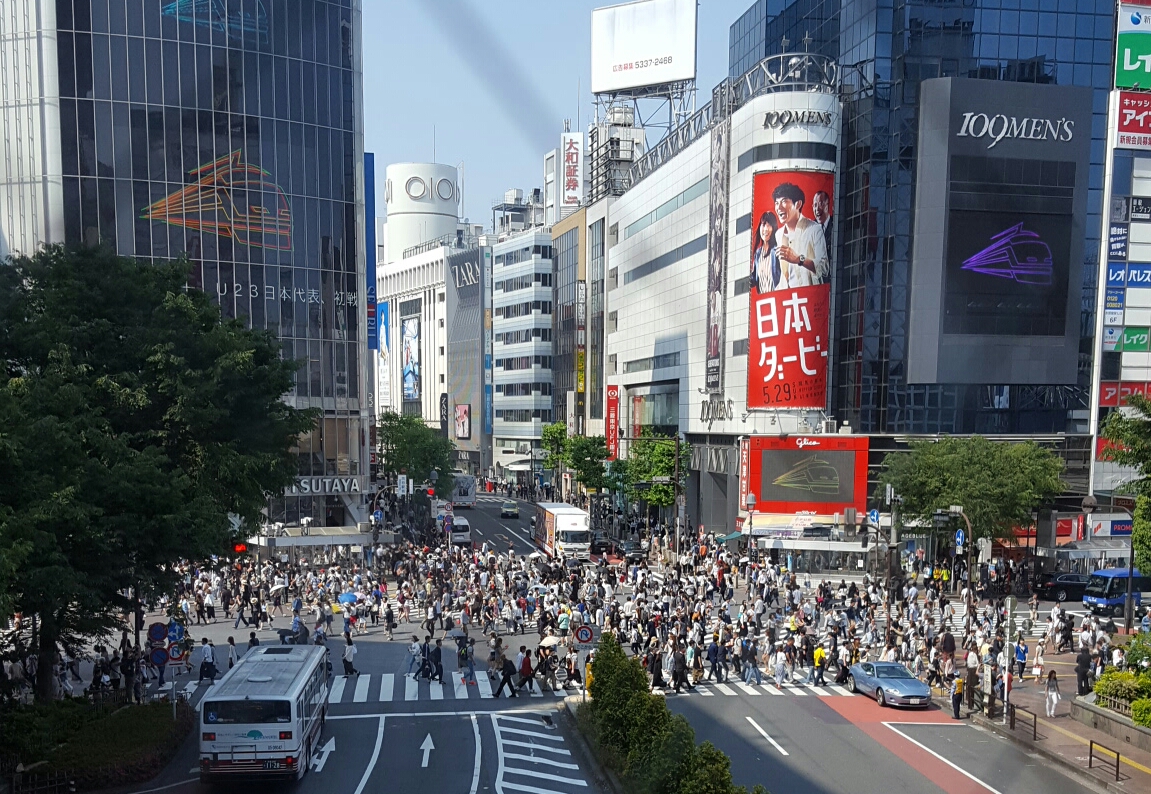
A main intersection in Shibuya. When the walk light flashes hundreds of people flood the street.


Tuesday, May 24, 2016

Haneda to Minamiazabu

I forgot to mention the good water at the hotel in Haneda. There was just a hint of cedar smell but I couldn't detect any taste but that of fresh water. There was an explanatory note in the room.

Also forgot to post a photo of one of the many flower shops we saw in Kawasaki. No matter the time of year flowers are always available.
Street-side flower vendor's goods

In place of the real flowers, above, most restaurants have realistic displays of plastic foods showing their best dishes 

Saturday we checked out of our hotel in Haneda with its tasty water and headed down to the subway system to make our way to our new hotel in Minamiazabu.
Multi-lingual self-serve ticket dispensing machine
First stop at any station is the ticket machine This machine accepts cash, has directions in Japanese, English, Chinese and Korean and dispenses tickets in values allowing travelers to go to any stop on that line. If you aren't sure which of the thirteen subway lines (with their 216 stations) that serve Tokyo you need to take to reach your desired destination there is a helpful map showing all those plus the main Japan Railway Line, other JR Lines, private railways and a couple of the main streetcar lines.
Tokyo's thirteen subway lines are color coded with numbered station markers which make it easy to get around

We bought tickets for the first leg of four, fed those tickets through the automated ticket reader and went to the platform to wait for our train. The ticket readers scan the magnetic code embedded in the ticket and punch a hole in each ticket and return it to the traveler at the other end of the scanner. When you go out of the destination station you feed your ticket into the scanner and if the fare is correct for that station a green arrow lights and out you go. If the fare is incorrect two batwing gates swing out blocking progress and you head for the fare adjustment machine or conductor's office to make amends.
Ticket readers scan the magnetic code and allow, or block, passage

These subway signs show destinations, times and track numbers. The times are departure times and are very accurate
In the Tokyo subways many stations have new safety gates to prevent accidents during rush hour. The gates are closed until the train stops then open allowing passage then close again before the train departs.
In many stations safety gates line the boarding area
We rode four different lines as we worked our way to Hiroo station in minamiazabu, near the New Sanno Hotel, our home for the next week. It was interesting riding the different subway lines through Tokyo. We were traveling light with only carry-on bags so navigating the escalators and stairways wasn't a burden and we traveled during the middle of the day on Saturday so the trains weren't crowded.

In some of the photos you see the word "Pasmo" which indicates you can touch the reader with your phone and the fare, or other charge, will be deducted from your on-line account. This same system works for vending machines, store express checkout lines and many other situations where small amounts of cash might be needed.


Monday, May 23, 2016

Japanese Hospitality

I always enjoy returning to Japan. The social graces still grease the wheels of civilization here. We enter a restaurant to cries of welcome, "Irashai, irashai mase." and leave to thanks, "Domo arigato gazaimashita."

On the long-haul trains where there are still conductors, they slide open the door of each car, bow to the passengers, check their tickets, slide open the car door on the opposite end, then bow again as they move on to the next car.

Waiters and clerks are invariably polite and respectful, remembering that it is the customers who pay their wages. I'm sure this is a novel concept to many Americans who have grown accustomed to clerks just putting in their time and public employees everywhere who act put upon to fulfill the simple tasks that comprise their jobs.

Tipping is a foreign concept in Japan yet wait staff in any restaurant serve diligently and with a friendly greeting for all. Courtesy is their password as they serve their clientele.

Hotels are another place where courtesy is never forgotten.

Friday morning I took off my Fitbit prior to taking a shower and after breakfast noticed it was missing from my wrist. We looked all over the room to no avail so thought I'd dropped it on the way to or while eating breakfast in the hotel dining room. I retraced my steps there and on the way back to the room stopped at the front desk and reported it missing and gave my room number. I was quite concerned since Glenn (older son) had given it to me last Christmas.

Ikuko and I went shopping in Kawasaki (as mentioned in my last post) and when we returned to the hotel my Fitbit was on the desk with a typewritten note from Housekeeping: "Dear Mr. Harold Rodenberger, Regarding your inquiry, we found it under the bed. Please enjoy your stay with us." and signed by Yumi Hasegawa.

I was so pleased they found it I sent an email to the hotel manager: (Wanted to copy and paste it here but I can't seem to figure out how to do it without covering half of this post so I'll retype.)

Subject: Accolades to Housekeeping

General Manager
Royal Park Hotel
The Haneda

Dear General Manager,

This morning I was afraid I had lost the Fitbit exercise tracker my son had given me as a Christmas present.

I took it off before showering and then missed it after returning from the Tailwind Restaurant. My wife and I checked our room, I retraced my steps to the restaurant and searched the floors along the way. All the searching was to no avail as we couldn't find the Fitbit.

This afternoon when we returned to our room from a shopping trip to Kawaaki I found that your housekeeping staff had found the device and left it long with a nice note.

Please pass my thanks to Ms. Yumi Hasegawa and he staff or finding the precious device my son had given me.

With Sincere Thanks,


//signed//
Harold Rodenberger
Room 619

I thought that would be the end of it but I was wrong. When we checked out on Saturday there was an envelope waiting for me and as we turned from the front desk there was the General Manager, Mr. Tobari, who shook my hand and wished us well.

We just can't get ahead of the Japanese in the courtesy game.

Here's the letter he wrote:

Thank you letter from the manager responding to my thank you letter


Seattle to LAX to Haneda, Japan

OnWednesday Ikuko and I caught a Delta flight at 0805 from Seattle to Los Angeles.

In LAX we met up with Dean and Kartina (our younger son and wife) and caught another flight to Haneda, the old main airport serving Tokyo before Narita came on line in 1978, after years of protests and what today would be called terrorist actions, but that's another story.

While waiting in the Seattle terminal I struck up a conversation with an older traveler who had been in the US Air Force before accepting a job traveling many places around the world. He was an interesting guy who called 'em as he saw 'em. I took a photo of his backpack.
Backpack of an outspoken traveler
Our flight across the Pacific was smooth and we landed at Haneda late Thursday after losing a day crossing the International Date Line.

Dean had made reservations for us at the Royal Park Hotel, The Haneda, which is located right in the terminal at Haneda. The hotel had its own restaurants but if we wanted to patronize any of the airport restaurants we just walked out of the hotel lobby and crossed above the security lines of departing passengers to find a restaurant we liked among the thirty or forty available.

The new (2010) international terminal building is well designed with the hotel, restaurants and shops, and monorail and train terminals constructed right into the overall building. Also there are parking facilities for short-term car parking and bus and taxi loading areas in sheltered areas within the building. 

Escalator from the arrival lobby to the train platforms
On Friday Ikuko and I decided to go to Kawasaki, a nearby city, to do a little shopping and look around. From our room we took the elevator to the lobby, walked a short distance, took an escalator down one floor, walked through the departure lobby, took another escalator down, walked thru the arrival lobby and then another escalator to the train platform and caught a train to Kawasaki. All this took place within the main Haneda International Terminal. 

Station guide showing the layout of that portion of the Haneda Airport International Terminal
Back in our hotel room, I noticed the complete lack of airport noise. One reason was the way the windows were constructed. It's the first time I've seen such a large noise isolation space between plate glass window panes. I must say that in our room I could detect NO outside noise.
The space between the sheets of plate glass was about ten inches
On the way from our room to the restaurant and shop areas there was an interesting large-scale rendition of an old castle with a stylized bridge.

Massive timbers were incorporated into this project


This is a functional bridge leading from one floor to another

Thursday, March 31, 2016

Sunset Over Puget Sound


Wednesday evening I caught the new Alaska Airlines nonstop flight from Raleigh-Durham (RDU) to Seattle-Tacoma (SEA).

The sun was shining at RDU when we took off at 1750 but as we headed west across the Appalachian Mountains clouds soon blocked our view of the earth some seven miles below.

I had a window seat in an exit row over the wing so had a pretty good view as we flew across our cloud-shrouded country. Many times I could see three layers of clouds and sometimes the turbulence was moderately severe. The wings acted more like a bird's with plenty of up and down motion and the cabin crew had to stow the service carts twice because of the bumps.

Finally we crossed the Cascade Mountains and the clouds cleared so I had a spectacular view of a sunset above the clouds and then over Puget Sound as we descended from the south on our landing flight path into the slight north wind.
As I looked out the window (porthole?)

What a little cropping will do


Southern Puget Sound comes into view with the Cascades below and Mt Rainier off to the left