Tuesday, July 21, 2020

Wild Thing

For the past two or three weeks I've been taking the occasional photo of wild plants that have found a niche in the Edmonds community. I find it somewhat amazing that life can be so tenacious. Wild plants grow wherever there is space, a little soil and moisture.
Himalayan blackberries (Rubus armeniacus) are an invasive species that has naturalized in many places. Here in western Washington, it can be found along roads, forest borders, farm fence-rows and anywhere it can find root in Edmonds. 

When I saw this plant growing in small plot of soil near a bus stop, I thought it was Yarrow. After returning home, I looked it up to confirm the ID. Now I'm not so sure but that it might not be a variety of Tansy. When I go by that way again, I'll bruise a leaf and see if that helps. I hope it's Yarrow since Tansy is generally an unwanted wild thing.  

Crown vetch growing in a roadside garden. I've seen this in other gardens and in untended plots, mostly in semi-shaded areas. Some varieties of vetch are good erosion control plants and many make good food for livestock during the winter and spring when grass is dormant.

Salal (Gaultheria shallon) is a common wild thing throughout the Pacific Northwest. This specimen was planted in a roadside border a couple years ago after a cedar hedge was removed. This plant is in full sun and seems to be enjoying the environment. Often I see salal in shady areas along trails in the nearby park, where it grows tall and makes a great home for squirrels and other small animals.
Oregon grape (Mahonia aquifolium) is native to our area and has been domesticated as an ornamental for use in gardens. When I was young, I tried the berries and found them to be almost inedible with a couple large seeds and a sour-to-bitter taste. Native Americans mixed the berries with salal berries to the benefit of both. The resultant paste was made into cakes that could be mixed with pounded dried meat and fat to make pemmican. When I was young, folklore had it that salal and Oregon grape could be made into a delicious jelly. I never saw any and it seemed to be like Alice's, "jam yesterday, jam tomorrow, never jam today," so one summer in 1975 or '76 I decided to make some. The effort failed for lack of juice. The salal berries are mushy and the Oregon grape berries had very little juice. I think they are better suited to pemmican than jelly.
California poppies (Eschscholzia californica) grow anywhere there is sun and well-drained soil. Around Edmonds, they grow wild where they can and are planted in gardens for showy flowers most of the summer. When I walk on cloudy, misty days or in the evening, the flowers are closed. I found it interesting that these plants were introduced to Chile, either as an escaped ornamental or in bales of alfalfa imported from California as animal feed. Now the poppies are doing better in their new home than those that stayed behind in California. 

I've known these wild things for years but never knew what they were called. It turns out that google isn't sure either. Some photos list them as "Little Yellow False Dandelions" while others call them "dandelion trees." All dandelions have a tap root and this variety, especially, enjoys the hot days of summer when the green lawns have turned brown. That long tap root reaches down to harvest whatever moisture there might be and the blooms soon release their umbrella seeds to find other brown pastures. All parts of the dandelion are edible and nutritious. Apparently they were eaten by our ancestors long before recorded history. 

Another interesting fact about dandelions is that the sticky white sap that oozes out when a leaf or the flower is cut, is the same kind of latex found in rubber trees. The wild dandelion has a small amount of this latex but scientists in Germany have bred a variety that has enough latex to be useful for making rubber. In 2015 a new manufacturing facility there made tires from the dandelion latex and is running tests on regular highways. In 2018 a Chinese company invested over $400 million to build a facility to make commercially viable rubber from dandelions. Who'da guessed the lowly dandelion would hit pay dirt as a latex plant?

Morning glory is another wild thing that seizes whatever opportunity is presented to greet the morning with its spectacular flowers. Fences, guy wires, hedges and other vines are pressed into service by the morning glory vine as it winds its way to full exposure. I didn't copy the Latin name because, according to Wikipedia, there are over 1,000 varieties of plants called "morning glory" and there is an on-going debate among experts to decide the proper nomenclature. Whatever the scientific name, the flowers are beautiful and have been bred in many shades of white through blue.

White clover (Trifolium repens) is part of systematic pasture strategy on farms but grows wild around town. The bees love clover but I didn't know that it is a good survival food. It's hard for humans to digest raw but if boiled for a few minutes it is easily digestible and high in protein and is a good source of vitamins.
The stinging nettle (Urtica dioica) has many uses. The leaves and flowers are eaten like spinach, the young plants can be used to make beer, the stalks contain fibers similar to linen, and the entire plant can be used for flogging as a punishment. I was surprised by this last but, according to Wikipedia, in Ecuador, the indigenous people punished serious crimes thus, "The sentenced perpetrator of a crime was flogged with stinging nettle, in public, naked, whilst being showered with freezing cold water.[45]" 

Nettles have long been a source of food, especially early in the growing season when other greens were scarce. Nowadays, when greens seem to grow on grocers shelves year round, people don't eat nettles as much. Two years ago, when I was trekking in Nepal, one of the tea-house owners cooked a dish for me from nettles we collected along the trail. They also heighten the yellow color of egg yolks when hens eat as little as 6.25 grams of dried nettle per kilogram of feed.

Fabric made of nettle fibers has been used to make clothing for thousands of years. Because of a potential cotton shortage, German Army uniforms were almost all made from nettle material in WWI. Recently companies in Italy, Austria and Germany have begun making cloth material from nettle fibers. 

The wild geranium (Geranium maculatum) grows wild in the eastern US and Canada. In Edmonds it is sometimes planted in gardens but it also has naturalized and is found in several shady places along my walks.
Fireweed (Chamaenerion angustifolium) is another wild thing found in many places around Edmonds. As with many native plants, the fireweed (so named for its ability to quickly grow on burned over land) stem and leaves are edible when very young. As it matures, the stem can be split and the inside eaten raw. The leaves can be dried and steeped for a tasty brew and it is valued as a medicinal herb.


Saturday, July 4, 2020

Daisies For a Restrained Fourth of July

Daisies that bring you joy are better than roses that bring you sorrow. Matshona Dhliwayo
This Independence Day being rather subdued, I thought the Daisy, being the uncelebrated flower that it is, would be a good symbol of the day. 

Some of my earliest memories are of the final years of WWII. There were no fireworks then on Independence Day, probably because gunpowder was going to the war industries. Rationing made life difficult and I don't remember eating a hot dog on the Fourth, or any other day, until later. Times were grim but Americans were sacrificing for the war effort. 

Other than during those war years, I don't remember a Fourth of July as restrained as what the virus has brought us this year. Americans are being asked to forego a degree of personal pleasure for the common good. I hope we are up to the task. 
Even constrained by concrete and a sturdy fence, these daisies smiled and nodded to me as I walked by their home. I was encouraged by their perseverance and determined to follow their example.
These small English Daisies and the showy Goblin Gallardia, below, each enjoy their place in the daisy world. I take that as a lesson. Even though I'm not the smartest, richest or strongest man in this world, I can find happiness in my own space.

I enjoyed my walk among the daisies. Returning home, I felt inspired to ignore life's petty constraints and search for the beauty that is often hidden in plain sight.

Always have something beautiful in sight, even if it's just a daisy in a jelly glass. H. Jackson Brown Jr.

Thursday, July 2, 2020

Lilies Galore

It's lily time in Edmonds. Found these lilies in people's yards on my walks around town the past few days. The exception is one that was growing in my sister's yard near Lake Stevens. I'll let you figure out which it is.

Some of the lilies have a wonderful aroma, but some don't smell at all. I can hear my brother saying, "Of course not dummy, they don't have noses." He was always the wise guy of the family.


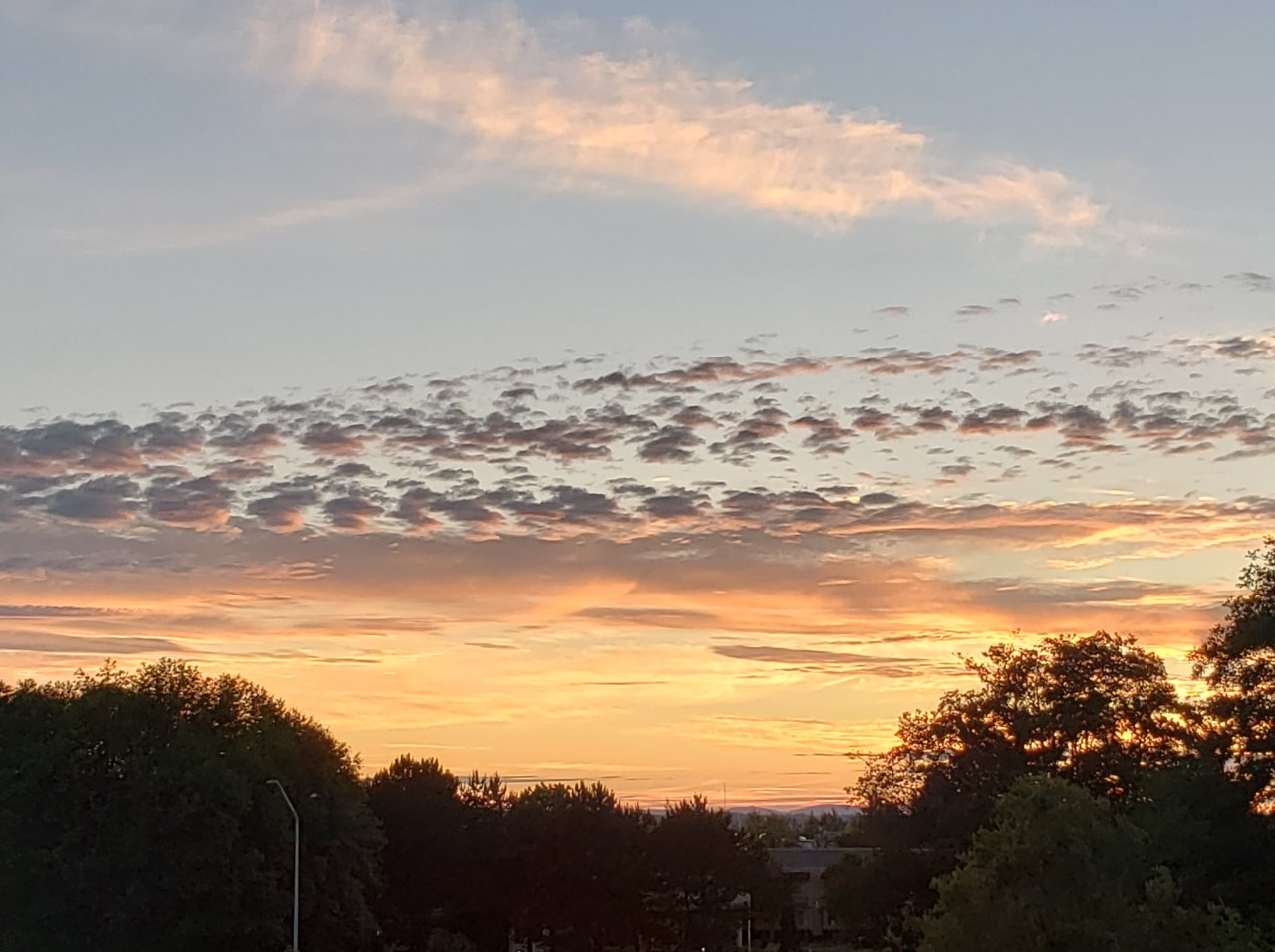
This isn't a lily but it is a gorgeous sunset. The photo was taken from my deck, looking northwest at 2113 (9:13 pm) on June 22nd, the longest day of the year this year.

Monday, June 22, 2020

Longest Day Dogwoods

Because this year is a leap year, the summer equinox (June 20th) came a day earlier than normal.

Sunday was not only Father's Day but also the longest day of the year in the northern hemisphere. Being it was such an auspicious day, I went for a walk in the afternoon after the rain stopped. As I walked I noted that the dogwoods were still in bloom.

Interestingly enough, the "flowers" we admire on dogwoods aren't actually flowers at all. They are a special leaf (bract) that protects the true flower and only unfurls after that flower is formed. These colorful bracts have another purpose in attracting pollinators. For ease of writing, henceforth I'll refer to them as flowers.

Flowering Dogwoods are native to the East Coast area of North America but other varieties are found in China, Korea and Japan. Those I admired on my walk are flowering dogwoods and often hybrids cultivated for their beautiful and long lasting flowers.
This fine specimen is just across the street from our condo. I noticed its blooms in early May during my walks and it's the one that got me thinking about the longevity of the dogwood flowers.

As the white dogwood's blossoms age they sometimes become tinged with pink. Note there are only four petals instead of the usual five found on flowers. Maybe it's because these aren't true flowers but beautiful leaves instead.
I saw this red dogwood about three miles into my walk, not far from our Edmonds waterfront. If you look closely, you can see three of the four that were growing along the property line. The hydrangea in the foreground will burst into bloom before long. It also has long lasting blooms. I've seen some amazing hydrangeas already in full bloom.
This angle shows all four of the red dogwoods above, screened by the flowering hedge in the foreground.

I've read that the wood of the dogwood is hard, durable and crack resistant. It is still used for making custom golf clubs, spindles, forks and similar tools requiring special wood. I'm thinking of making a cane so will look for a choice peace of dogwood raw material.
Although dogwoods prefer partial or even full shade, I've noticed that many varieties thrive in full sun. Of course, full sun in our part of the country only occurs about 15% of the time. We are the cloudiest city in the country with 226 days of heavy cloud and another 82 days when clouds cover at least one-quarter of the sky. This according to the NOAA National Climactic Data Center. Humans might not like the clouds but the dogwood prefers that kind of weather.
This pink dogwood has a good combination of flowers and foliage. I also noted that it might have good raw material for making a cane. Although, I must admit the owner might feel differently.
This vacant lot is on Main Street, two blocks from the ferry terminal and just south of our post office. It has been vacant since we moved to Edmonds and has sported various odd sculptures and whimsical art displays. Last year on the Fourth of July, what must have been the family of the owner set up a BBQ inside the fence and had a party. Today after I left the post office I noticed this Holstein cow placidly gazing out at the passing scene. I decided that would be a good recipe for contentment in today's crazy world. Placid serenity is worth a lot. 


Monday, June 15, 2020

Edmonds Flag Day Walk

Today is Flag Day so thought I would keep an eye out for flags as I walked around Edmonds.

Because of the virus and social distancing, I try to walk on streets that are not so attractive to pedestrians. We live in what they call the "Edmonds bowl" with hills on three sides. On the fourth side is Puget Sound. The waterfront is about four blocks to our west but has lots of walkers so I don't often go that way.

To our north and northeast lies Lynnwood, to the east is Mountlake Terrace, to the southeast is Shoreline, and to the south is Woodway. If you're curious or don't know the local geography, Seattle is on the other side of Shoreline and Everett is north of Lynnwood. So no matter which way I walk away from the water, outbound is uphill, return is downhill.

Today I chose to walk southeast up the long slow hill about one and a half miles to Westgate and then up and down the smaller hills, north on 9th, thinking I would make my way to Caspers Street where I'd turn west down the hill to 3rd thence south through downtown to our place.
Just before sunset a few days ago.
Early this morning I replaced my usual American Flag with the POW/MIA Flag. According to the General Services Administration (GSA Bulletin FMR 2008-B6), this flag is flown on the following six days: Armed Forces Day, Memorial Day, Flag Day, Independence Day, National POW/MIA Recognition Day (designated by Presidential Proclamation, historically, the third Friday of September), and Veterans Day. Today being Flag Day, I flew it as a reminder about our missing in action and prisoners of war.

Looking NE in this photo, a person would never think we were in the heart of Edmonds. The flat ground just beyond the outbuilding is part of the Edmonds Marsh, a wetlands preserve that extends about 150 yards to the left (south) of the building. The much larger portion of the Marsh extends to the west out of sight in this photo. The fruit trees, and beyond, the Alder, Maple and fir trees are on the western portion of two under-developed lots. On the eastern part of each of the lots is a single family residence facing Third Avenue, but the remainder of the lots show signs of once being gardens and orchards. Now they are prime real estate waiting for a buyer to develop them into condominiums. I hope that doesn't happen for a few years. 

Not far (1/4 mile +/-) beyond the trees on the right lies the Edmonds ferry terminal. Due north three blocks is Main Street with all its businesses. To the east and south are condos and apartment buildings with the occasional house scattered here and there. This marks the start of my walk today.
Two blocks away at 4th and Howell, I saw these two flags. The one in the foreground is flying every day but the one on the deck is flown only on holidays.

As I slogged my way up the hill toward Westgate, I found myself thinking of the current demonstrations and rallies for Black Lives Matter. This led me to reflect on my long-time friend Dave Z, deceased five years now. I wrote about him earlier in this blog HERE. He and others of our generation have lived through vast changes in America. Changes that have brought great progress in our society, but which still leave changes to be made.

As usual, the demonstrators want change to happen immediately. That seldom happens and meaningful change requires cultural adjustments that take time. As an example, in 1967, when I was assigned to duty in South Carolina, my wife and I were in violation of that state's miscegenation laws. Today, interracial marriage is not uncommon and most Americans approve. That's a huge change which took time, but change it did.
 Turning west on 9th at Westgate, I soon came upon our local cemetery.

As I've grown older, cemeteries remind me that, just as we are born and live our lives, so we must die, to complete the cycle. When I was young, like most younger people, I had an immortality complex. Our current battle with the corona virus pandemic should reinforce the idea that we all face death sooner or later.

I think it's important to remember that our neighbors in whichever cemetery we choose won't care if we wore the latest fashions, drove the best car or were the CEO or janitor of the company. Looking the cemetery in the eye, I've come to realize there are important parts of life that involve things like attitude, personal time and service to others.

A little north of the cemetery, I passed the two-mile mark and continued up and down the more gentle hills on 9th Avenue. At the three-mile mark, I decided to forego the longer route via Caspers Street and head on down the hill on Alder Street toward home.
 On holidays in Edmonds, some of the service organizations such as Kiwanis and Rotary place flags in specially drilled holes in the sidewalks throughout the business districts. This shot is looking north along 5th Avenue, a couple blocks south of Main Street.

From here, I turned down the hill on Walnut and walked the final two blocks to home. My Pacer app said I walked 3.67 miles in one hour, one minute and 33 seconds at a pace of 3.6 mph. I guess I didn't waste much time shooting photos.

It feels good to write a blog entry after a little more than six months away. It's the longest I've taken a break from the blog. I think part of the reason is the impact of the corona virus, but mostly it was inertia. I've also been studying Japanese on line which takes anywhere from 30 minutes to two hours per day. But maybe that's just an excuse since I studied today yet found time to write this.

I resolve to be more diligent in the future.


Sunday, November 10, 2019

Yost Park

Yost Park is a small (48 acres) park in the heart of Edmonds, not far from our place. It has about 1 1/2 miles of trails and is not busy at this time of year. When I was there, there were three cars in the large parking lot. That day I took a walk in the park.
Nearest the road that leads to the large parking lot there is a tennis/pickle ball court. The day I was there, there were two players just getting organized.

Moving down the hill from the courts there is a small playground for children.

The pool is closed this time of year but in the summer months it enjoys good crowds. It is the only outdoor pool in Edmonds so is popular during the warm season.
 The trails range from a wide abandoned street that runs from the parking lot to the east. It is great for wheelchair and stroller users. Other trails seem to be pretty well maintained but some are steep and most are narrow.
 Shell Creek runs through the park down the hill from the east. One trail (Shell Creek Trail) wanders along and back and forth across the creek. Others circumnavigate the park or crisscross it at various points.
 There are several good bridges, although I noticed some with handrails that had been smashed by falling limbs or small trees. There is also a boardwalk that comprises part of the Shell Creek Trail.

In the early part (1902?) of the last century the Yost family dammed the creek and ran a pipe down to Edmonds, furnishing clean fresh water to the new town. Several times I saw remnants of the concrete dams and pools left over from the old water works.

It was interesting to explore the park in the fall. I'll go back to observe the changes brought by the other seasons.

Monday, October 28, 2019

Edmonds Kingston Ferry

Please join me on a sunny day, riding the ferry from Edmonds to Kingston.  

As you come down the hill toward the ferry terminal, the ferry traffic lines up on the right. There is one lane on the shoulder until it splits into two lanes about a quarter mile from Dayton Ave, just in front of the toll booths. Usually there is only one lane open but when traffic is heavy they open the curb lane (where I'm standing to take this photo) as well. During heavy travel days I've seen the line backed up all the way to West Gate, a little over two miles.
Here the two lanes feed across Dayton Avenue to the toll booths and parking lot. 

During busy times all the toll booths are usually open. The parking lot behind the booths (where
the white car is) holds enough cars to fill one of the two super ferries that serve this route.
This is the ticket booth for motorcycles and bicycles. The cycles load first and debark first.

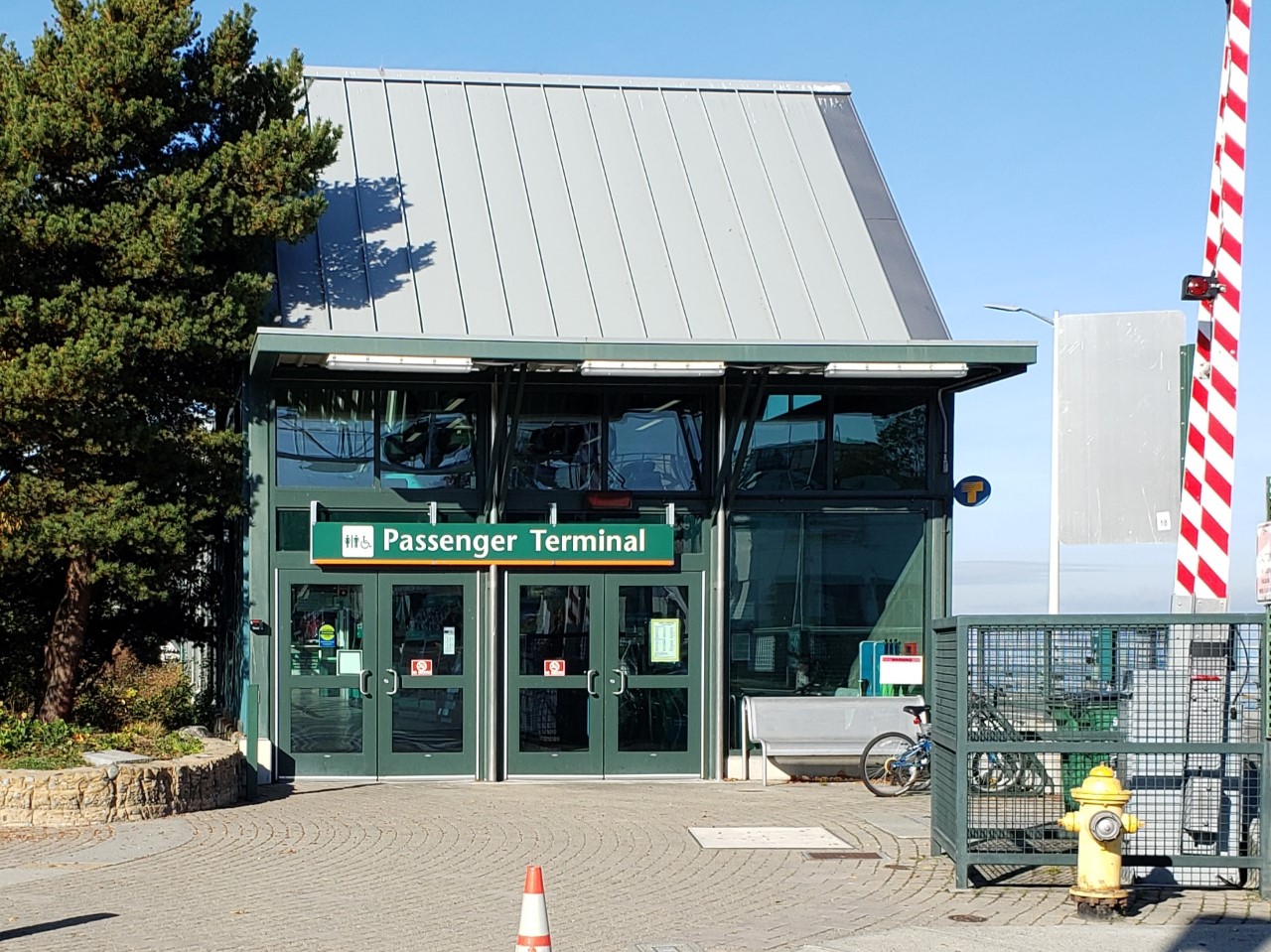
Entrance for foot passengers.
These two ticket machines are on the right just inside the passenger entrance door. Most people use ORCA
Cards so these don't get much use.

This enclosed ramp leads from the ticket office to the drawbridge onto the ferry. You can just see the drawbridge
raised in the distance to the left of the ferry berth.

These turnstiles allow passengers using ORCA Cards or other digital fare holders to pass through.

Here the drawbridge is lowered onto the ferry upper deck.

Wheelhouse of the Walla Walla. The Spokane is the other Jumbo Class ferry on the Edmonds route. Each of them
can carry approx 2,000 passengers. The Walla Walla carries 188 vehicles, the Spokane 206.

Passenger seating areas like this are on both ends. Along the windows there are booths, many with tables.

The galley serves finger food, drinks, etc.

Mt Baker off to the north just before we sailed.

Temperature was about 42 degrees but the north wind plus apparent wind from our forward motion
made it cold out on the forward decks.

Approaching the Kingston terminal, our trip is almost finished, about 20 minutes after departing Edmonds.